Last updated:
Hot weather does not create one single towing problem. It reduces the margin for several systems at the same time: tires carry their normal load while pavement temperature rises, the cooling system has less room to shed heat, batteries and electrical connections work in a hot engine compartment, and the driver may be dealing with a long grade or slow traffic. A short inspection before departure is much easier than diagnosing a warning light, vibration or fluid leak beside a Texas highway.
This checklist is intended for diesel pickups pulling utility, equipment, livestock or travel trailers. It helps an owner collect useful facts and spot reasons to pause. It does not replace the truck and trailer manuals, the driver-door labels, a weight calculation for the exact combination or a professional inspection.
Begin with ratings, not assumptions
Write down the truck’s VIN, gross vehicle weight rating, front and rear axle ratings, payload label, tire size and cold inflation pressure. Then record the trailer’s gross vehicle weight rating, the expected loaded weight, tongue or pin weight, and the ratings printed on the hitch and ball or fifth-wheel components. The lowest applicable rating in the complete combination is the limit; a stronger-looking part does not increase the rating of another component.
Count people, tools, fuel containers, bed equipment, coolers and other cargo as part of the load. A toolbox, replacement bumper, auxiliary tank or bed-mounted equipment can consume payload even when the trailer is unchanged. If the calculation is unclear, weigh the loaded truck and trailer by axle rather than relying on an empty brochure figure. Keep the scale ticket with the other trip information so a technician can see the actual front, rear and trailer axle loads.
Inspect tires while they are cold
Check truck and trailer tire pressure before highway driving or direct sun has warmed the tires. Use the pressure specified by the applicable vehicle or trailer label and manufacturer guidance, not the maximum number molded on the sidewall as a universal setting. The National Highway Traffic Safety Administration tire guidance explains why the placard, correct size, load capacity, cold pressure and routine inspection belong in the same decision.
Look across the entire tread and both sidewalls where visible. Stop for a cut, exposed cord, bulge, separated area, object in the tread, valve damage or a tire that is losing pressure. Uneven wear can point to alignment, suspension or pressure problems that should be addressed before a long tow. Confirm that truck and trailer tires have adequate load capacity for the measured axle loads and that no axle is overloaded even when the total combination appears to be below its overall rating.
Do not skip the spare. Confirm that it is the correct type, inflated, accessible after the trailer is loaded and accompanied by tools that fit the actual lug nuts. A roadside plan should also account for the weight of the wheel and a safe lifting point. If pressure, wear or fitment is uncertain, schedule a tire inspection before departure rather than treating the first fuel stop as the test.
Check cooling-system evidence before opening anything
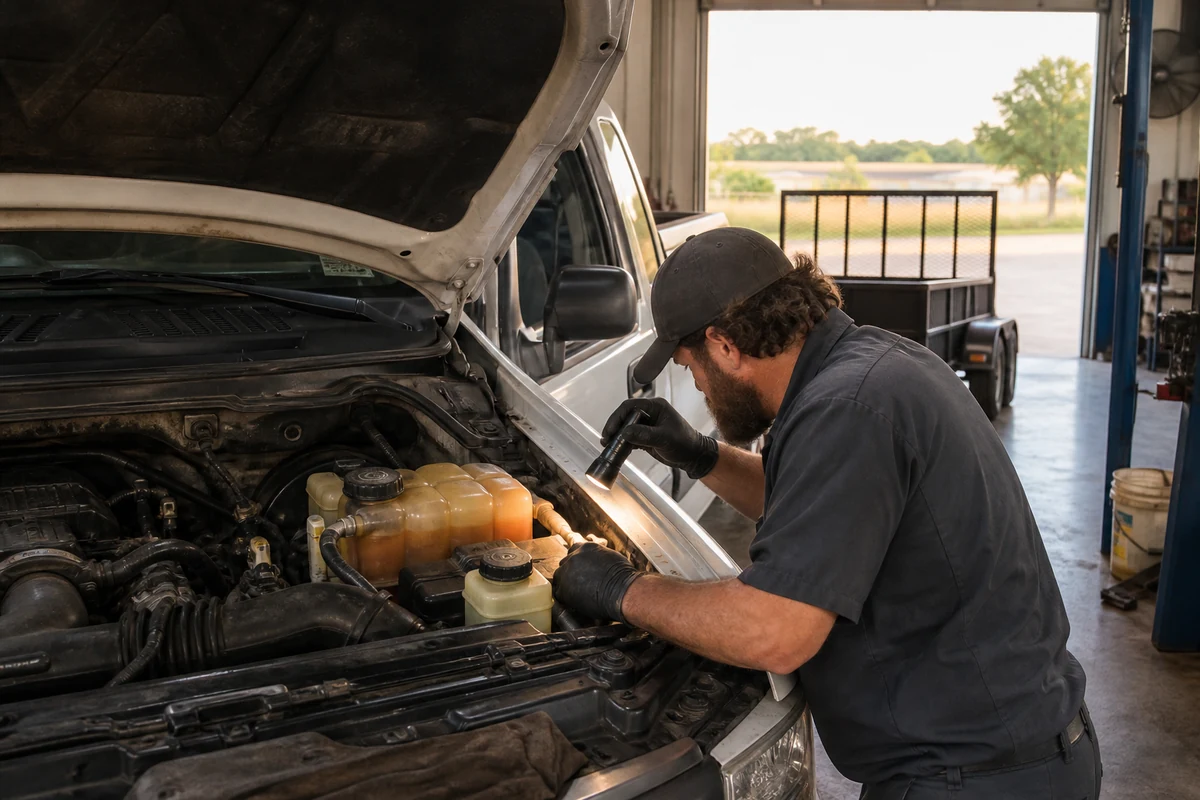
With the engine completely cool and the truck parked on level ground, inspect the coolant reservoir level according to the owner’s manual. Look for fresh residue, wet hose connections, damaged hoses, a loose or deteriorated belt, and debris blocking the cooling stack. Never remove a pressurized cooling-system cap from a hot engine. A low level, repeated need to add coolant, sweet odor, visible leak or prior temperature warning requires diagnosis; topping off without finding the cause is not a repair.
Use only the coolant type and mixture specified for the vehicle. Mixing incompatible products or adding an unspecified sealer can create another problem. If used coolant must be handled, keep it in a closed, labeled container and follow local disposal rules. The U.S. Environmental Protection Agency guidance on motor-vehicle waste explains why antifreeze and other automotive fluids must not be discharged into the ground or an improper drain.
A cooling concern should be inspected under the conditions that reproduce it. Tell the technician whether temperature climbs while idling, on a grade, with air conditioning on, or only while towing. That pattern is more useful than a vague description of “running hot.” Related service may involve belts, airflow, a fan system, a leak, a thermostat, a radiator, a water pump or another cause; replacing parts without testing is not a sound pre-trip plan.
Look for fluid leaks and service intervals
Check the parking surface and the underside of the truck and trailer for fresh fluid. Follow the manuals for engine oil, transmission fluid, brake fluid, power-steering fluid where applicable, differential service and transfer-case service. Some systems do not have an owner-serviceable dipstick, and a fluid can be at the wrong level even when there is no puddle. Do not crawl under an unsupported vehicle or trailer.
Towing often changes the severe-service schedule. Compare current mileage and operating history with the exact maintenance chart for the truck. Note recent repairs and any fluid that has required repeated addition. Bring part numbers or invoices if a nonstandard filter, pan, cooler or other component is installed. For a diesel, fuel-filter age, water-in-fuel warnings and evidence of fuel leakage deserve attention before the load is connected.
Inspect belts, batteries and electrical connections
A quick visual check can find a frayed belt edge, glazing, missing ribs, cracked insulation, a loose battery hold-down or corrosion at a connection. Do not place hands or tools near a running belt or fan. Heat can expose a weak battery or marginal connection, especially after the truck has sat at a stop with lights, trailer circuits and climate control operating.
Start the engine and watch for a slow crank, charging warning, check-engine light or new message. Confirm that the instrument cluster completes its normal bulb check. If a warning remains on, use proper diagnostic testing rather than clearing codes to make the dashboard look normal. A code is a clue, not a complete diagnosis, and clearing it can remove useful freeze-frame information.
Test brakes, breakaway equipment and trailer lights
Inspect the truck’s brake fluid level as the manual permits, and look for leakage, damaged hoses or an abnormal pedal. Confirm that the trailer connector locks in place and that running lights, brake lights, turn signals and hazard lights all operate. Test the trailer brake controller at low speed in a safe area following the controller and trailer instructions. The trailer should contribute smoothly without locking a wheel or pushing the truck.
Check the breakaway switch, cable routing and battery according to the trailer manufacturer’s procedure. The cable needs its own secure attachment point and must not be looped around a safety chain in a way that prevents correct operation. Safety chains should cross where required, have enough length for turns, avoid dragging and use rated attachment points. If the brakes pulse, pull, grind, overheat or need unusual pedal travel, obtain brake service before towing.
Secure the hitch and the load as one system
Verify that the coupler or fifth-wheel jaws are fully engaged, the pin or latch is secured, the jack is raised, and all stabilizers and steps are stowed. Inspect the receiver, hitch, ball, mounting hardware and frame area for loose fasteners, deformation, cracks or contact marks. Weight-distribution and sway-control equipment must be adjusted for the exact combination and installed according to its manufacturer’s instructions.
Inside the bed and trailer, restrain tools, ramps, batteries, fuel containers and loose equipment with rated tie-downs attached to sound anchor points. The NHTSA secure-load guidance emphasizes tying cargo down directly, avoiding overload and checking the load again during the trip. Close and positively latch doors, gates, compartments, windows and roof equipment. After the first few miles, stop in a safe place and recheck the hitch, straps, tire condition and any item that could settle.
Use a deliberate walk-around sequence
A consistent order reduces missed items. Start at the driver door with labels and tire pressure, move around the truck clockwise, inspect the hitch area, continue around the trailer, and finish in the cab. Use a written list instead of relying on memory. One person can inspect while another calls out each item, but the driver should still complete a final walk-around.
- Confirm ratings, load distribution and the route before connecting.
- Measure cold tire pressure and inspect tread, sidewalls, valves and the spare.
- Check the cool engine bay for fluid level, leaks, belts and loose connections.
- Connect and inspect the hitch, chains, breakaway cable and electrical plug.
- Test every exterior light and the trailer brakes.
- Secure cargo, doors, ramps and compartments with rated equipment.
- Set mirrors, brake-controller gain and navigation before entering traffic.
- Plan safe stops for rechecks rather than waiting for a symptom.
Plan for heat once the trip begins
Select a route that matches the combination’s clearance, fuel range, grade capability and safe stopping options. Leave more following distance and avoid abrupt steering, braking and acceleration. On a grade, use the transmission and engine-braking strategy described by the manufacturer. Do not coast in neutral. If a temperature or pressure warning appears, reduce risk, find a safe place to stop and follow the owner’s manual; continuing until power is lost can turn a warning into damage.
During each stop, look, listen and smell before touching anything. Compare tire appearance, look for a shifted strap or leaking hub, and notice a hot-brake odor or new sound. Do not touch a brake, hub or tire to judge temperature, and do not crawl under a combination parked on an unsafe shoulder. A tire losing pressure, smoke, a fluid leak, a damaged hitch component or abnormal brake behavior is a reason to stop the trip and obtain help.
Close the checklist with recalls and documentation
Before a major trip, enter the truck and trailer VINs into the NHTSA recall lookup and review unresolved safety recalls. Trailer appliances and accessories may have separate manufacturer notices, so keep the make, model and serial information available. Store emergency contacts, insurance information, the weight ticket and service history where they can be reached without unloading the trailer.
A useful pre-trip inspection produces a decision, not just a checked box. If every rating, condition and function is understood, document the pressures and proceed conservatively. If the numbers do not reconcile or the truck shows a leak, warning, vibration, brake concern or cooling symptom, correct it first. A scheduled diesel and truck inspection with the loaded-use details gives the technician the context needed to test the right systems before the hottest part of the trip.